Once upon a time in the northern region of Ecuador there was a family of happy volcanoes living in perfect harmony. Among them was Maria Isabel of the Snows of Cotacachi, an independent-minded maiden. She brought trouble upon herself and the family. She was indifferent to the love proposition of an older volcano named Rucu Pichincha, or old Pichincha in Quechua, one of South America’s native languages. He was so smitten by her that he became sleepless. He did what sleepless volcanoes do: he threw lots of hot lava into the valley below. According to the legend, Cotacachi played hard to get but finally agreed to Rucu’s love. A son was born from their liaison. He was named Guagua Pichincha, or young Pichincha in Quechua.
Life with Rucu was too dull for free-spirited Cotacachi and out of boredom she started an affair with another powerful volcano named Taita or Miguel Imbabura. Rucu was devastated by her betrayal, and decided to punish his unfaithful lover. Consequently Rucu kidnapped little Guagua and moved near Quito, the capital of Ecuador. The loss of her child was so heartbreaking that Cotacachi could not help it and cried. She cried so much that her tears filled up a lake called Cuicocha located at the foothill of the Cotacachi volcano.
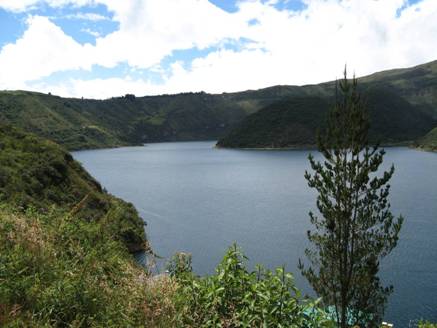
The Cuicocha crater lake.
Ecuador volcanoes are deceptive. Doomed Cotacachi is now quiet and extinct by geologists’ interpretation, but Cuicocha is the one to be monitored. Gases are accumulating at its bottom and may burst into a toxic cloud anytime. Nowadays Rucu Pichincha is watching peacefully over Quito. In contrast, his temperamental son Guagua occasionally displays eruptions of anger which cover Quito with white ashes. Volcanoes have a mind of their own. Taita Imbabura remains as untrustworthy as the Indian legend implied. Is it extinct or only sleeping? No one knows for sure. To be on the safe side, geologists have positioned a couple of seismographs in its vicinity. Ecuador is a geologist’s paradise.
Geology is a science full of nuances: one can learn that ten Ecuadorian volcanoes are classified between “active” and “probably extinct.” Among this lot, seven volcanoes are fully active. Tungurahua is not a big volcano but it is one of the busiest; it rarely stops shooting smoke, ashes and rock. Thanks to its fiery but predictable temperament the volcano has become a top tourist attraction. It can be observed from selected bedrooms in the neighboring Luna Runtum hotel. The show is worth the trip to the small city of Baños, some 180 km south of Quito. Baños means bath in Spanish, thermal bath in this particular case.
The poster boy for elusiveness and deceptiveness is without a doubt the Reventador volcano. This modest-sized volcano is hidden deep in the jungle north-west of Quito and was nearly forgotten until it erupted without warning couple of years ago. Since Guagua was quiet at the time, the clueless Quiteños (the inhabitants of Quito) didn’t know where the ashes were coming from. Now they have two close volcanoes to watch!
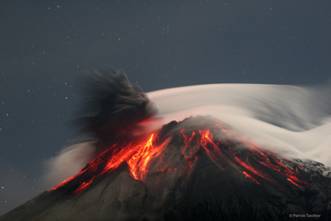
Tungurahua, unknown source
Although volcanoes are on the map they are more than often invisible to the naked eye. One may drive along the so-called highland volcano highway and only see a couple of characterless hills. Volcanoes are elusive things commonly hiding behind thick clouds, particularly when a tourist is holding a camera. One can spend weeks waiting to snap the perfect picture of the perfect volcano like the Cotopaxi, one of the highest Ecuadorian mountains (5.897m); and it may never come into view. The majority of tourists will leave Ecuador with their camera card full of pictures of cloud-capped volcanoes. They will have to buy postcards as evidence of their trip.
If the Ecuador volcanoes are elusive and mainly seen in books and postcards, rural people accept to be photographed. Indian people are not camera hams but will not berate you for stealing a picture. However, they may casually request a dollar for the favor. Many years ago, the government adopted the U.S. dollar as the local currency. It was a drastic way to stop the rampant inflation. Americans tourists are in for a surprise as they arrive in Ecuador. They will have to use the unloved one-dollar coin. There are certainly more dollar coins circulating in Ecuador than in the entire United States. It is quite exotic to see Indians on market day haggling with fists full of dollars.
Markets and village fairs make Ecuador special. The Saturday Otavalo market is famous with locals and tourists alike who visit the place for unrelated purposes. Otavalo is a town located some 120km north of Quito in a lush valley at the foothill of the Cotacachi volcano of the legend. Locals and tourists mingle at the animal market. The former do the selling and the buying and the latter take pictures. The market easily compares with Noah’s ark. Domestic animals— mainly black pigs, sheep, goats, llamas, chickens, rabbits and guinea pigs—peacefully share the same area. Dogs and cats are also for sale and it is not unusual to spot cats with rabbits and chickens sleeping in the same basket.
The Otavalo market is above all popular with tourists for its arts and crafts from Ecuador and neighboring countries. And like elsewhere, gullible foreign tourists will be cheated. One common trick is to sell Peruvian polyester garments as Ecuadorian alpaca wool!
In addition to the dollar, cheap gasoline is also something Ecuador and the USA share. Even if gas is much cheaper in Ecuador the locals are not driving Hummer SUVs yet. The government heavily subsidizes gasoline and consequently its citizens only pay $1.40 a gallon. Taxis and buses are plentiful and very cheap. The bus fare for the four hour long Quito-Baños trip costs $3. Hiring a taxi for long trips is nothing exceptional. A taxi will charge $35 to go to Otavalo.
By Middle East standards Ecuador is a modest oil producer who, for ideological reasons, has joined the OPEC cartel. Ideology is something which is not in short supply in Ecuador thanks to the posturing of its young president Rafael Correa. The president is a faithful follower of Hugo Chavez of Venezuela. In some circles, Correa is dismissed as a Chavez puppet. Correa is derogatively regarded as “first stooge.” When oil was selling above $140 a barrel, Chavez lavishly bankrolled Correa’s populist initiatives. Venezuelan largesse is a thing of the past; now Correa has to make do with his own limited resources.
Consequently the tax policy of the government is getting increasingly imaginative. The amount that tourists may have saved on gas is spent on a hefty exit tax. A $40 tax is levied on all foreign tourists when they leave the country at Quito airport. Ecuador is clearly taking a socialist turn. Coincidently Ecuador’s vice president is conveniently named Lenin.
Tourism is rather well organized. Many tourists visit mainland Ecuador as an afterthought, often as addition to their Galapagos island cruise package; they are not disappointed. Hotels are comfortable and many are converted haciendas which often date back from the Spanish colonial period. Some are working farms which maintain the rural flavor.
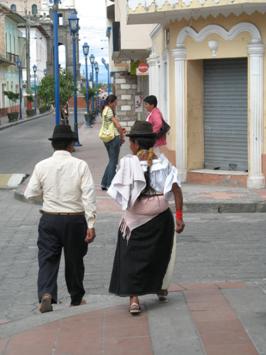
Street of Cotacacatchi Town |
One noteworthy hacienda is the 18th century Pinsaqui, near Otavalo. It is nestled at the foothill of Umbaburu volcano, the seducer of Cotacachi. Pinsaqui is often mentioned in the history books of Ecuador. Simon Bolivar the liberador of Latin America slept there. Actually during his years as an independence fighter he moved around a lot and slept in many haciendas. His stays are duly recorded and the bedrooms where he slept are coveted by guests. Hugo Chavez, who regards Bolivar as his mentor, has not been invited to sleep in Pinsaqui yet.
|
Ecuador has an impressive colonial past highlighted by the rich baroque churches and monasteries. In 1978, Quito was one of the first cities to be designated as an UNESCO World Heritage site. The Spanish conquistadors brought with them the Catholic religion and it became the centre of the spiritual and cultural life of the colony. Quito is protected by the statue of the Virgin Mary which stands on the Panecillo hill overlooking the city. The statue is uncommon as the virgin is winged and seems to be dancing. Many think that if she was not bolted down she would fly away!
Noteworthy was the life of Santa Mariana de Jesus who became the first saint of Ecuador in 1950. She lived in 17th century Quito and gave her life to protect the city from a devastating earthquake. Legend has it that she made a prophetic observation, namely that earthquakes will not destroy the country but politicians will. She may have been canonized for her prediction!
Beatrice Labonne,
Rio de Janeiro, March 30, 2009. |




 URL site map
